Welcome to the Mathematical World!
John Dalton
Father of Modern Atomic Theory
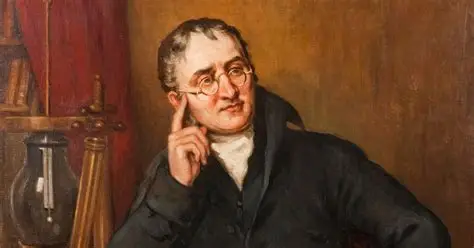
John Dalton (1766–1844) was an English chemist, meteorologist, and physicist, best known for formulating the modern atomic theory. Born in Eaglesfield, England, Dalton displayed remarkable curiosity and intellect from a young age, teaching himself mathematics and natural philosophy while still a child. He worked as a teacher, and his early studies in meteorology and gases eventually led him to groundbreaking discoveries in chemistry.
Dalton’s Atomic Theory
Dalton proposed that matter is composed of small indivisible particles called atoms, which combine in fixed ratios to form compounds. His main postulates include:
- All matter is made of atoms, indivisible and indestructible.
- Atoms of the same element are identical in mass and properties, while atoms of different elements differ.
- Atoms combine in simple whole-number ratios to form compounds.
- Chemical reactions involve the rearrangement of atoms, not their creation or destruction.
This theory provided a systematic explanation for chemical reactions and the law of multiple proportions.
Law of Multiple Proportions
Dalton also formulated the law of multiple proportions, which states that when two elements form more than one compound, the ratios of the masses of one element that combine with a fixed mass of the other are simple whole numbers. For example:
\[ \text{CO: } \frac{12 \text{ g C}}{16 \text{ g O}}, \quad \text{CO}_2: \frac{12 \text{ g C}}{32 \text{ g O}} \]The ratio of oxygen masses combining with a fixed mass of carbon is \(16:32 = 1:2\), illustrating Dalton’s law.
Studies on Gases and Meteorology
Dalton conducted extensive research on gases and their pressures, leading to what is now called Dalton’s Law of Partial Pressures: in a mixture of non-reacting gases, the total pressure is equal to the sum of the partial pressures of individual gases:
\[ P_\text{total} = P_1 + P_2 + P_3 + \dots \]He also made detailed observations of the atmosphere and contributed to meteorology, keeping careful records of temperature, pressure, and humidity over decades.
Color Blindness Research
Interestingly, Dalton was color blind himself. He studied the condition scientifically and published the first paper on it, which led to the term “Daltonism” being used for color blindness in some countries.
Legacy
John Dalton’s atomic theory laid the foundation for modern chemistry, providing a framework for understanding chemical reactions and the composition of matter. His work influenced generations of chemists and physicists, eventually paving the way for the discovery of subatomic particles and quantum theory. Dalton is remembered as one of the great pioneers of scientific thought in chemistry and physics.

All rights reserved by the Mathematical Unity
Contact: +8801400044645
Email: mathematicalhorse1453@gmail.com
Our Discord Server: Mathematical Unity [Ulus Riyadiyat]